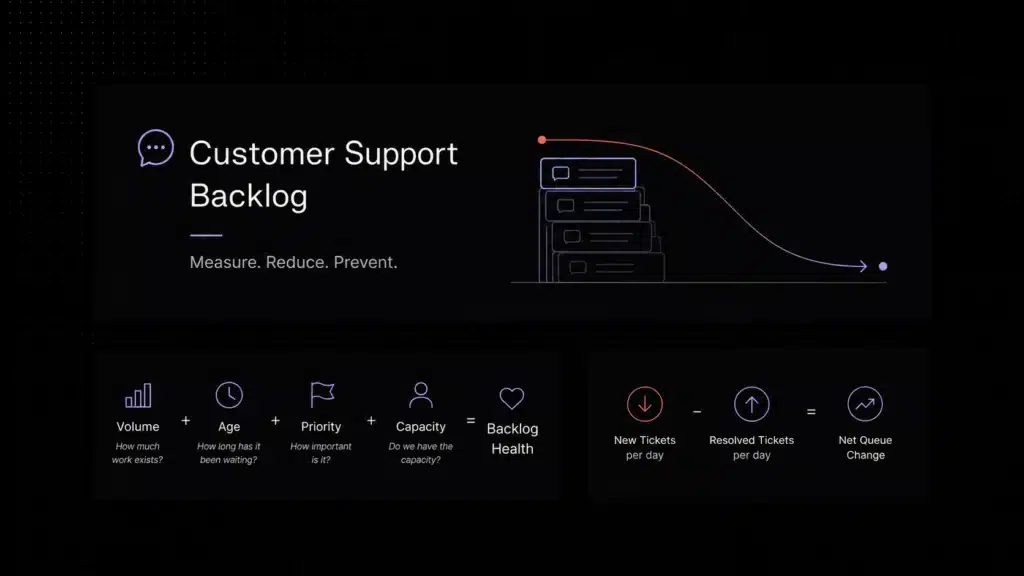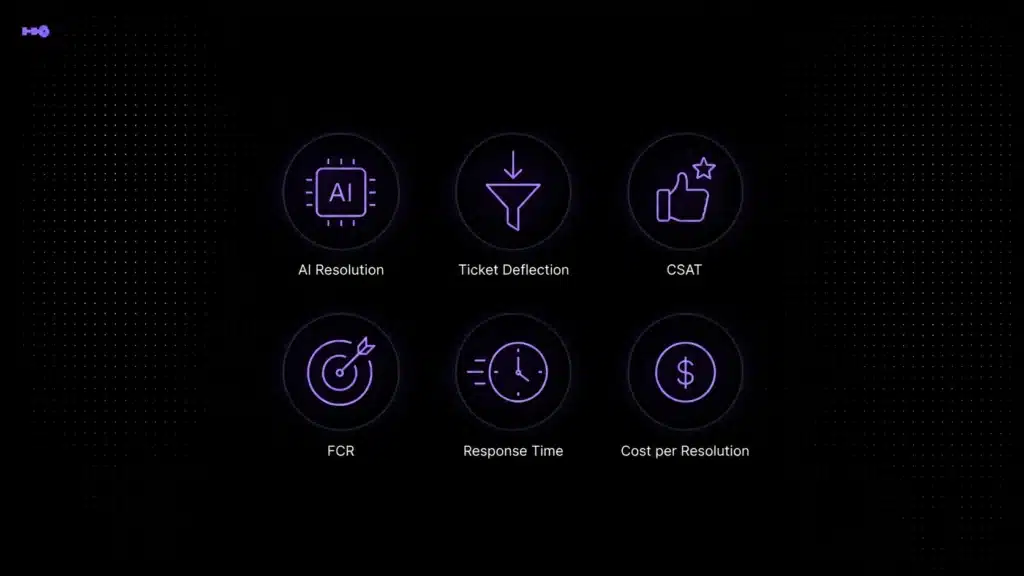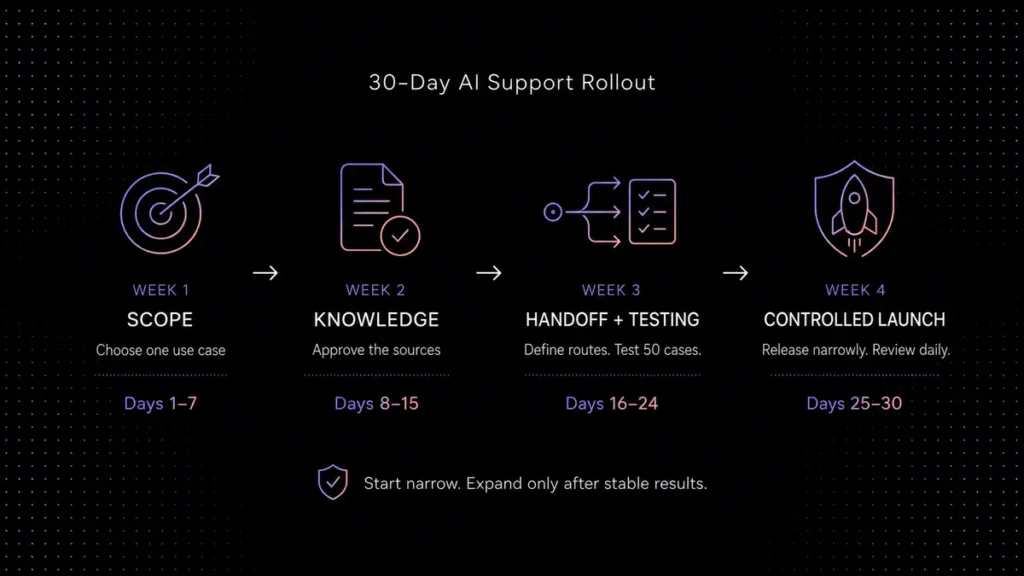
| What is customer support burnout? | Customer support burnout is the fatigue, disengagement, and loss of performance that builds when a team has to absorb more pressure than the support system can handle, driven not only by volume, but by repetitive tickets, context switching, unclear ownership, and operational drag that accumulates faster than leaders typically expect. |
|---|
Support burnout rarely starts with one dramatic moment. It usually builds quietly.
At first, the team just feels busy. Then the queue stays full longer than usual. Repetitive questions keep coming back. Agents spend more time jumping between tabs, checking old conversations, re-reading policies, and cleaning up handoffs. Response quality becomes harder to keep consistent. People are still working hard, but the work feels heavier every week.
That is why customer support burnout , and the broader pattern many leaders also describe as customer service burnout ,is often an operations problem before it becomes a people problem.
When these three factors stack together, burnout accelerates. Repetition drains energy. Context switching drains focus. Weak workflows drain momentum. Research on customer service burnout also points to operational overload and repetitive pressure as major contributors, not just individual resilience. That is why telling the team to “be more resilient” rarely works for long. The environment keeps recreating the same strain. See this breakdown of customer service burnout causes.
The better approach is to treat burnout as a support-design problem. How much of the team’s workload is predictable? How much of it could be prevented? How much time is being lost to context switching, weak self-service, unclear ownership, and manual work that should not be manual anymore?
This guide breaks customer support burnout down that way. We will look at what it actually looks like in a SaaS support environment, why support workload gets heavy faster than leaders expect, and which workflow, self-service, and automation changes reduce pressure without lowering service quality.
What customer support burnout actually looks like
In practice, it does not always look dramatic. Some teams do not talk about burnout directly at all. Instead, you see smaller signals: replies get shorter, patience gets thinner, handoffs get messier, and agents start solving the ticket in front of them rather than thinking clearly about the customer behind it. Small errors increase. Escalations feel more frustrating than they should. The queue never seems to reset.
In SaaS support, burnout often shows up in five ways:
First, the team feels constantly reactive. Customers surface issues before support sees them. Nobody feels ahead of the queue. Second, repetitive tickets eat too much time. Password resets, billing clarifications, onboarding questions, and the same feature misunderstandings keep coming back. Third, context switching gets out of control. Agents jump between inboxes, docs, customer histories, internal notes, and product tabs just to answer a basic question. Fourth, workload becomes uneven. Some agents get buried while others spend time on less urgent work because routing and ownership are loose. Fifth, quality starts drifting. Not because the team stopped caring, but because the work became harder to do well at speed.
That matters because burnout does not stay contained inside the team. It changes the customer experience too. When agents are overloaded, first responses slow down, replies become less specific, follow-up slips, and customers start repeating themselves more often. Burnout is expensive long before someone resigns.
Why support workload gets heavy faster than teams expect
A lot of support teams assume workload grows in a straight line. More customers means more tickets, and more tickets means you add more people. In reality, support workload and customer support workload usually grow in a messier way than that.
As the product becomes more capable, the support surface gets wider. As channels multiply, the same team has to monitor more places. As the customer base becomes more varied, the range of questions gets broader. And as expectations rise, speed and consistency matter more than ever.
That means workload is not just about ticket count. It is about the total effort required to resolve the queue well.
Gallup’s employee burnout research found that 76% of employees experience burnout at least sometimes, while 28% say they feel burned out very often or always. Gallup also identifies unfair treatment and unmanageable workload as two of the strongest workplace factors connected with burnout. For support teams, this matters because incoming demand is often externally driven: ticket volume can rise faster than staffing, routing, documentation, or automation can absorb it. When teams are expected to handle more work without structural relief, burnout becomes a predictable operating risk, not a personal resilience problem. Gallup’s employee burnout research reinforces why reducing workload friction matters as much as reducing ticket count.
A team can feel overloaded even when ticket volume looks manageable on paper. One hundred conversations are not equal to one hundred conversations. A queue full of repetitive questions with poor routing, missing context, and unclear next steps can create more stress than a smaller queue with clean ownership and strong self-service.
This is where many leaders get misled. They see rising pressure and conclude that the team is understaffed. Sometimes that is true. But often the bigger problem is that the system is asking agents to do too much low-value, preventable, and fragmented work.
If five agents spend half their day answering the same billing clarification, searching for account history, or manually triaging tickets that could have been routed automatically, the issue is not simply headcount. It is support design.
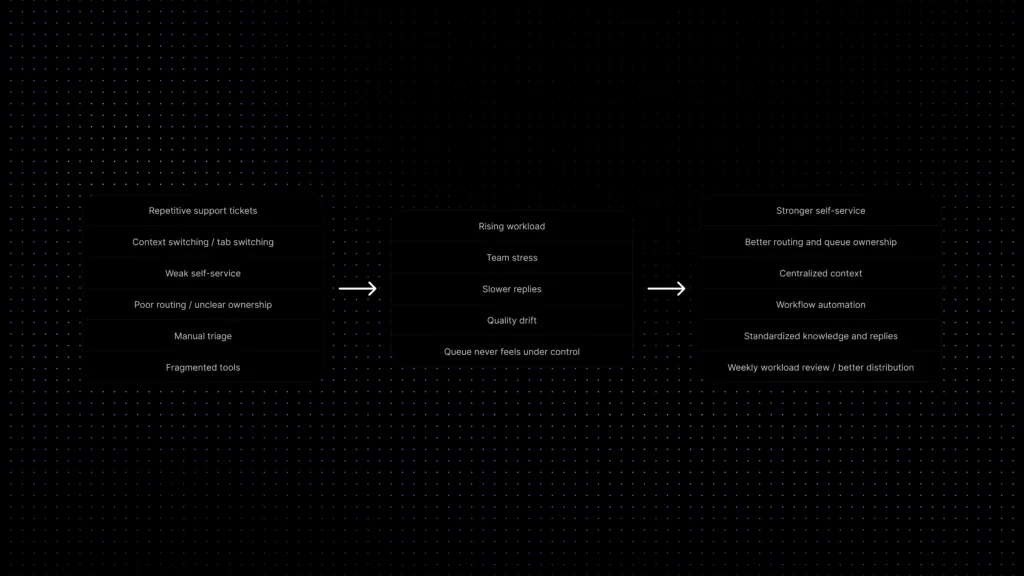
The hidden causes: repetitive tickets, context switching, and weak workflows
Support burnout rarely comes from one source, but three operational drivers show up repeatedly.
The first is repetitive support tickets. These are exhausting because they create the feeling of motion without progress. The team is busy all day, but the work does not move the system forward. It just replays over and over. Common examples in SaaS include onboarding confusion, password and login questions, billing explanations, plan limits, account permissions, and feature how to requests.
The second is context switching. This is one of the fastest ways to make support feel heavier than it should. An agent opens the inbox, checks the CRM, scans the help center, looks for a previous thread, pings a teammate, reviews internal notes, and then finally writes the reply. Even when each step is small, the cognitive cost adds up. By the end of the day, the team is not only answering customers. They are constantly rebuilding context.
The third is weak workflow design. Poor routing, unclear queue ownership, inconsistent escalation paths, and manual triage create invisible drag. Agents start work they should not own. Specialists lose time on basic questions. Managers step into tickets just to move them along. Everyone feels busy, but nobody feels in control.
When these three factors stack together, burnout accelerates. Repetition drains energy. Context switching drains focus. Weak workflows drain momentum. That is why telling the team to “be more resilient” rarely works for long. The environment keeps recreating the same strain.
How support automation and self-service reduce burnout pressure
The most reliable way to reduce burnout is to remove avoidable effort from the queue.
That is where support automation and customer self-service matter. Not because automation replaces the team, and not because self-service makes support less human. They matter because they reduce the amount of repetitive, fragmented work agents have to absorb manually.
Good customer self service takes obvious, high-frequency questions out of the queue before they become tickets. That might mean a clearer help center, better in-product guidance, a stronger billing FAQ, or an AI-supported knowledge experience that helps customers find the right answer faster. The point is not to push customers away. The point is to resolve simple issues in the fastest channel for that issue.
Good automation removes manual steps inside the support workflow. It routes the right tickets to the right owners, applies tags, triggers reminders, flags aging tickets, and reduces the amount of operational cleanup agents do between conversations.
Together, self-service and automation create a healthier support environment in three ways. They reduce repetitive volume. They reduce switching and triage effort. And they protect agent time for the work that actually requires judgment, empathy, and product understanding.
That last part matters. Burnout is not only about working hard. It is often about doing too much work that should never have reached the agent in the first place.
What to fix first before telling the team to “be more resilient”
If the team looks tired, frustrated, or constantly behind, do not start with morale slogans. Start with diagnosis.
Look for where the workload is being created. Which ticket types repeat most often? Which channels create the most interruption? Which agents get pulled into work that should have been routed elsewhere? Where does the team lose the most time before the real problem-solving even begins?
In most SaaS support teams, the first fixes are not glamorous. They are practical, and they reduce support team stress faster than motivational speeches ever will.
Tighten ownership so queues do not feel ambiguous. Fix routing so specialists are not doing level-one triage. Clean up macros and saved replies so common answers are easier to send and easier to personalize. Improve the help center around the top repetitive issues. Review where agents have to switch tools just to answer a question. Remove manual status checks that could be automated.
None of this sounds as exciting as a major AI rollout or a hiring plan. But these are usually the changes that reduce pressure fastest.
A useful rule: before you ask the team for more resilience, make sure the system has earned that request.
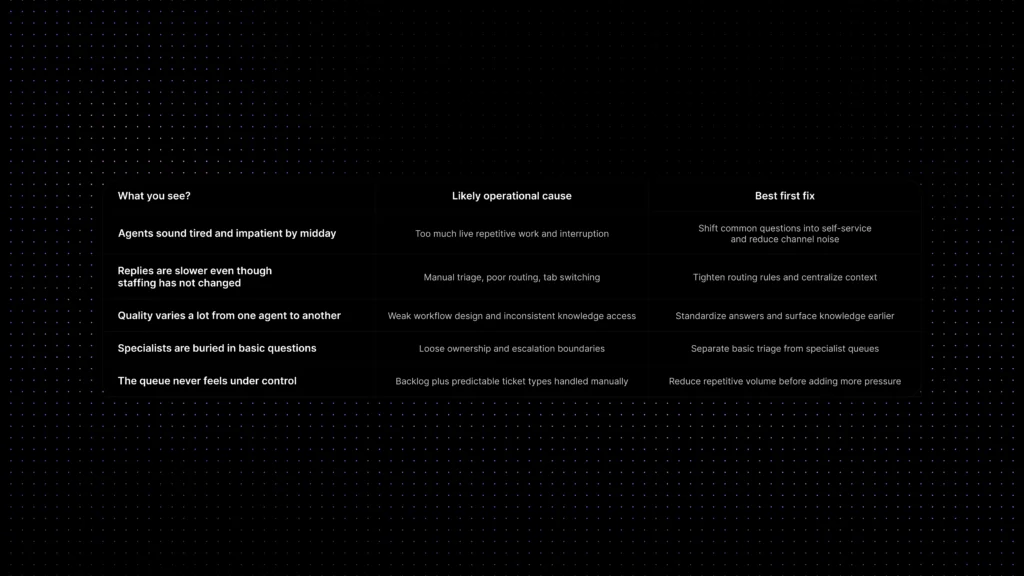
Common burnout symptoms and the operational fixes behind them
| What you see | Likely operational cause | Best first fix |
|---|---|---|
| Agents sound tired and impatient by midday | Too much live repetitive work and constant interruption | Shift high-frequency questions into self-service and reduce channel noise |
| Replies are slower even though staffing has not changed | Manual triage, poor routing, and tab switching | Tighten routing rules and centralize context |
| Quality varies a lot from one agent to another | Weak workflow design and inconsistent knowledge access | Standardize common answers and surface knowledge earlier |
| Specialists are buried in basic questions | Ownership and escalation boundaries are too loose | Separate basic triage from specialist queues |
| The queue never feels truly under control | Backlog plus predictable ticket types are being handled manually | Reduce repetitive volume before adding more pressure to the team |
The systems that reduce support workload without lowering quality
Support leaders often worry that reducing workload means lowering service standards. In practice, the opposite is usually true. The right systems reduce pressure and improve consistency at the same time.
A better knowledge base lowers repeat questions and gives agents a cleaner source of truth. Smarter routing protects specialist time and shortens time-to-owner. Shared context reduces back-and-forth and helps the next agent pick up the thread without making the customer repeat the story. Workflow automation removes small but draining tasks such as tagging, assignment, reminders, and status checks. AI-assisted drafting and summarization can reduce effort too, especially when agents still review and control the final reply.
The point is not to automate everything. The point is to stop spending human energy on work that does not need fresh human effort every time.
This is also why support workload and support quality should be reviewed together. If the system reduces agent effort but creates colder, less accurate, or less trustworthy support, it is not a win. Good operational fixes protect both the team and the customer experience.
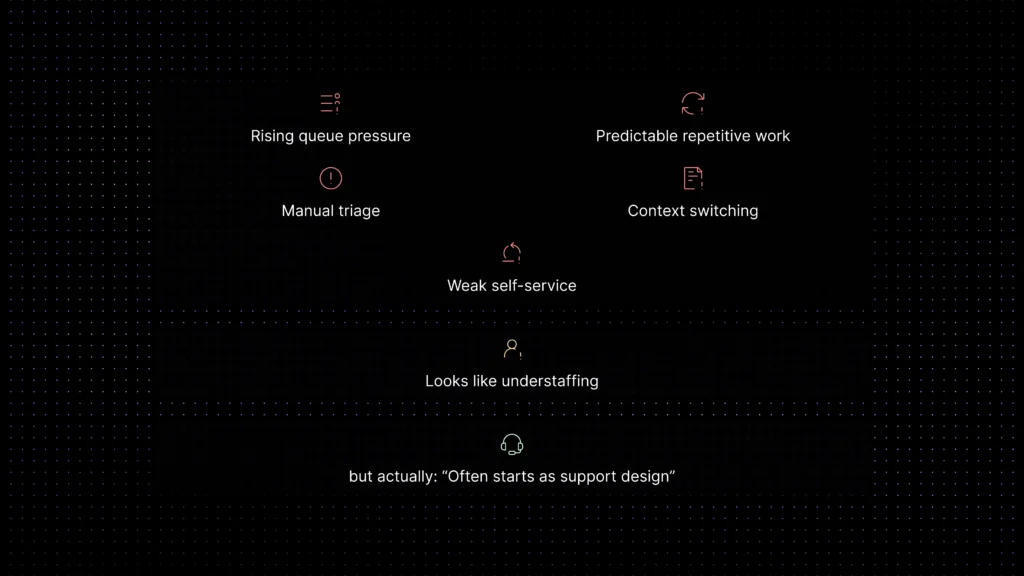
How to measure whether support workload is getting healthier
Reducing burnout should not mean guessing whether the team feels better. Support leaders need to measure whether the system is actually removing avoidable effort from the queue.
Start with metrics that show workload quality, not just workload volume. Ticket count matters, but it does not explain how heavy the work feels. A queue with repetitive, poorly routed, context-heavy tickets can drain a team faster than a cleaner queue with the same number of conversations.
- Repetitive ticket share: How much of the queue comes from repeat issues that self-service or automation could prevent?
- Time to owner: How long does it take for a ticket to reach the right person?
- Context-switching load: How many tools or tabs does an agent need to answer a common question?
- Misroute rate: How often do tickets move between people before reaching the right owner?
- Queue aging: How many tickets remain open longer than expected?
- Workload distribution: Are the same agents carrying the hardest or most urgent work every week?
These metrics help leaders see whether the support system is becoming healthier. The goal is not only to make the queue smaller. The goal is to make the work clearer, less repetitive, and easier to handle well.
A practical burnout-prevention checklist for support leaders
Before you jump to hiring, use this checklist. If several of these are still broken, burnout is likely being created by the system more than by team attitude.
| Fix first | Why it matters | What to monitor |
|---|---|---|
| Document the top repetitive ticket types | You cannot reduce workload you have not named | Share of queue taken by repeat issues |
| Improve self-service around the top 5 recurring questions | This is usually the fastest way to reduce manual volume | Deflection rate and repeat-contact rate |
| Tighten routing and queue ownership | Ambiguity creates stress and slows work | Misroutes, escalation rate, and time-to-owner |
| Reduce context switching | Fragmented tools create hidden fatigue | Tabs, systems, and steps needed per reply |
| Automate low-value workflow steps | Manual cleanup drains energy without improving support quality | Assignment time, tagging time, aging tickets |
| Review workload distribution weekly | Burnout often starts as uneven load, not total load | Per-agent queue load and queue aging |
What burnout prevention does not solve on its own
Operational fixes matter a lot, but they do not solve everything.
If a team is already deep in burnout, workflow changes alone may not be enough. Managers still need to address coaching, schedule design, time off, role clarity, and psychological safety. Some teams are not only overloaded; they are also under-supported.
There is also a point where hiring really is necessary. If the queue is healthy, self-service is strong, routing is clean, and the team is still overwhelmed by legitimate complexity, then capacity may truly be the constraint. The mistake is not hiring. The mistake is hiring before the predictable operational drag has been removed.
So the goal is not to turn burnout into a pure systems conversation. It is to stop pretending burnout is only a personal one.
Where Inquirly fits
This is exactly where support platforms either relieve pressure or add to it.
When conversations, routing, knowledge, automation, and context live in disconnected tools, the team pays the price in focus and energy. A better system gives agents one place to work, one clearer workflow to follow, and fewer manual steps between question and resolution.
For SaaS teams, that usually means three things: stronger self-service for repetitive issues, cleaner workflow automation for routing and triage, and shared context that reduces rework across conversations.
That is the role Inquirly can play. Instead of treating burnout as a soft issue at the end of the org chart, it helps teams reduce the operational pressure that creates burnout upstream: repetitive tickets, fragmented workflows, weak context, and too much manual handling.
Conclusion
Customer support burnout is not only about stamina. It is about how much unnecessary effort the support system asks people to carry every day.
If your team is buried in repetitive tickets, jumping between tools, and cleaning up weak workflows by hand, burnout is not a mystery. It is a predictable outcome.
The good news is that the fixes are usually more concrete than they seem. Reduce repetitive volume. Strengthen self-service. Tighten routing. Centralize context. Automate the low-value steps. Then measure whether the queue feels lighter because the system is cleaner, not because the team is simply pushing harder.
That is how support becomes more sustainable as the company grows.
If your team feels busy all day but never fully ahead of the queue, start by looking at the system around the work. That is usually where burnout begins , and where the best relief comes from.