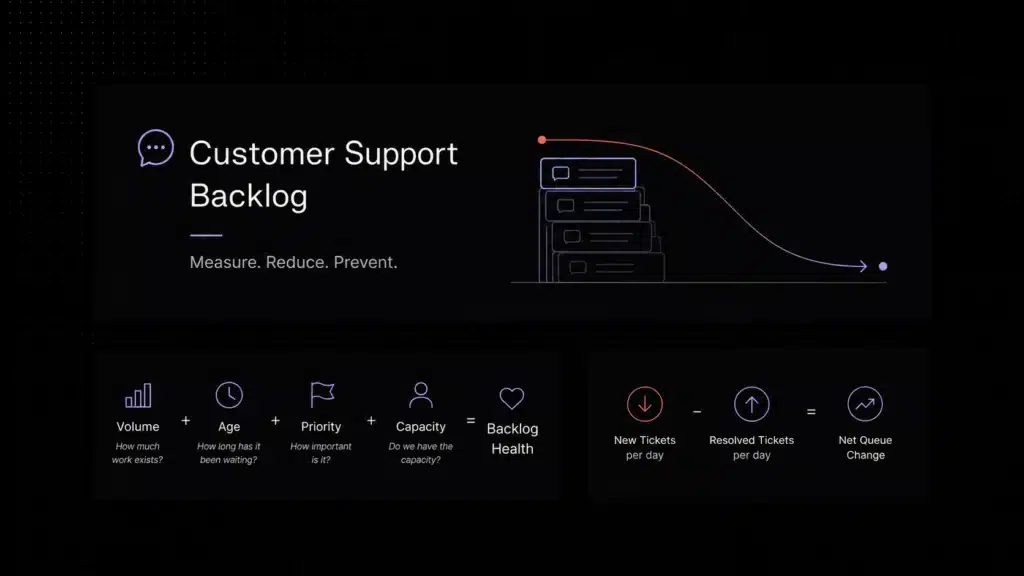
Somewhere in your support queue, a customer is asking the same question your team answered yesterday. And last week. And probably during a random Tuesday in March when everyone was pretending the backlog was “under control.”
That is not a bad support team. That is customer support at scale.
The right AI chatbot for customer support helps you answer repetitive questions, route tricky conversations, reduce ticket volume, and keep human agents focused on the stuff that actually needs a human brain. The wrong one traps customers in a loop where they type “agent” like a magic spell. Nobody wins, except maybe the rage-click industry.
This guide compares the best AI chatbots for customer support in 2026, with a focus on real support work: tickets, help center answers, troubleshooting, billing questions, refunds, account issues, handoff to humans, and the quiet daily horror of “just checking in on this.”
We are not ranking generic bots, lead-gen widgets, or shiny demo tools that look amazing until a customer asks something mildly specific. This list is for teams that need an AI customer service chatbot that can actually help customers without creating a second support problem shaped like a chat bubble.
Try Inquirly free if you want an AI-first support platform with ticketing, omnichannel conversations, workflow automation, knowledge base management, and Aily, Inquirly’s AI support assistant, without starting with enterprise-level complexity.
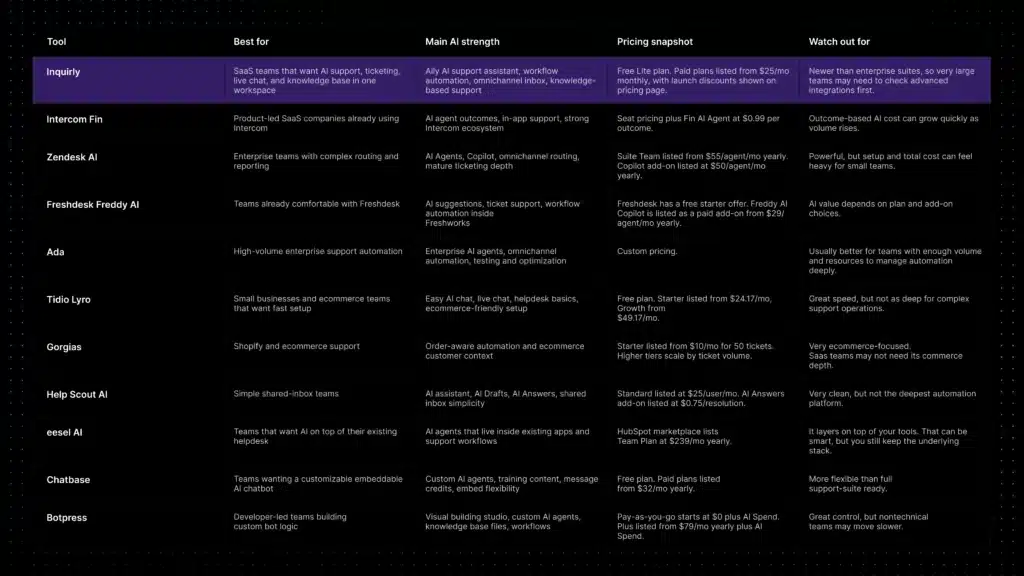
Best AI Chatbots for Customer Support: Quick Comparison
This table is the shortcut. Because yes, you could read eleven vendor websites and three pricing pages each. You could also assemble furniture without instructions. Both are legal, neither is a personality trait.
Pricing snapshot checked on June 17, 2026 from public vendor pricing pages. Pricing changes, usage limits change, and vendors enjoy making plans just complicated enough to require a spreadsheet. Always confirm current pricing before buying.
How We Evaluated (Including Our Own Product)
We’re not going to pretend this is a neutral third-party audit, Inquirly runs this blog, and Inquirly is on the list. Here’s how we handled that:
- Criteria came first, ranking came second. We defined the six criteria below before scoring any vendor, based on what actually matters when a customer is waiting for an answer, not on features Inquirly happens to have.
- Every vendor is scored against the same criteria, using public pricing pages and product documentation. Inquirly’s entry additionally reflects our own hands-on use of the product, since we can’t get equivalent internal access to competitors’ systems.
- We call out real limitations, including Inquirly’s, see “Watch out for” in the comparison table and in each product’s own section.
- The “best pick” varies by use case. We don’t claim Inquirly is the best fit for enterprise, ecommerce, or developer-led teams, the use-case table routes those readers to Zendesk AI, Gorgias, and Botpress/Chatbase instead.
If you want a fully independent view alongside this one, cross-check against user reviews on sites like G2 or Capterra before deciding.
We looked at:
- Answer quality: Can the chatbot answer from approved help content, product docs, and business rules, or does it freestyle?
- Human handoff: Can it pass full context to a human agent without making the customer repeat the story?
- Support workflow fit: Does it connect with ticketing, live chat, email, help center content, and omnichannel conversations?
- Setup time: Can a real support team launch it without a second product roadmap?
- Pricing clarity: Can you predict the bill?
- Best-fit use case: Is it actually built for SaaS, ecommerce, enterprise, small business, or developer customization?
How We Ranked These Customer Support AI Chatbots
A pretty chatbot demo is easy. A support chatbot that does not embarrass your team in front of customers is harder.
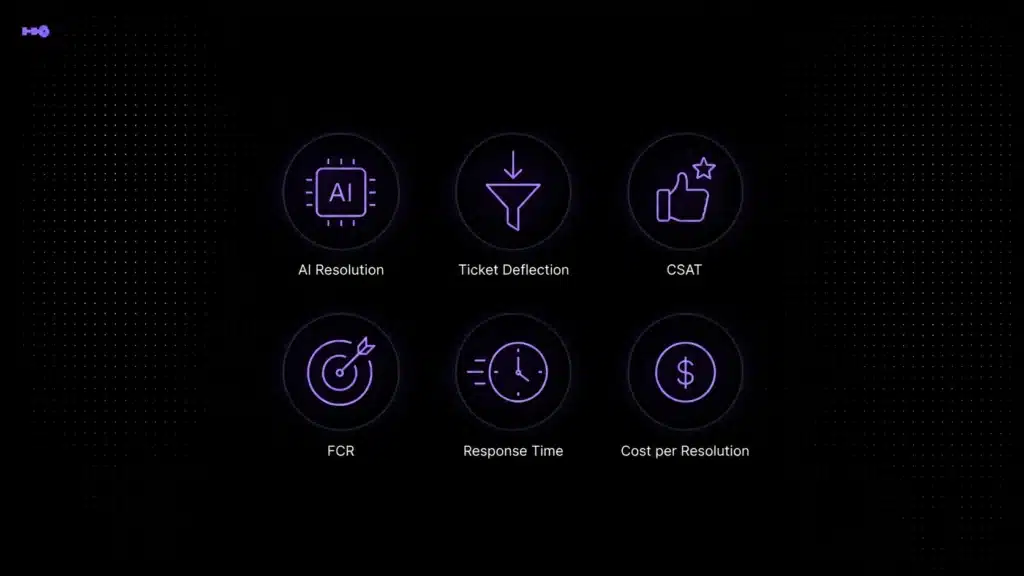
For this comparison, we looked at the things that actually matter when a customer is waiting for an answer:
- Answer quality: Can the chatbot answer from approved help content, product docs, and business rules, or does it freestyle like a confident intern with no access to the facts?
- Human handoff: When the bot gets stuck, can it pass full context to a human agent without making the customer repeat the entire story?
- Support workflow fit: Does it connect with ticketing, live chat, email, help center content, and omnichannel conversations?
- Setup time: Can a real support team launch it without turning implementation into a second product roadmap?
- Pricing clarity: Can you predict the bill, or do you need a finance degree, a scented candle, and emotional support?
- Best-fit use case: Is the platform actually built for SaaS, ecommerce, enterprise support, small business, or developer customization?
We also looked at current search intent. People searching for best AI chatbots for customer support are usually not looking for a dictionary definition. They want a comparison, a shortlist, pricing signals, use cases, and a buying recommendation. So that is exactly what this page gives them, because making readers hunt through fluff is how bounce rates become a cry for help.
This comparison is built from vendor pricing pages, product documentation, and direct hands-on use of Inquirly’s own support workflow, checked and refreshed on June 17, 2026.
1. Inquirly: Best AI Chatbot for SaaS Customer Support
Inquirly is the best choice for SaaS teams that want customer support AI without adopting a massive enterprise suite before they need one.
Its biggest advantage is the combination of omnichannel inbox, ticketing, workflow automation, knowledge base management, and Aily, Inquirly’s AI support assistant, inside one support workspace. That matters because most support chaos does not come from one missing feature. It comes from conversations, tickets, docs, and team workflows living in separate tools that do not talk to each other. Software fragmentation: humanity’s most boring villain.
Inquirly is especially useful when your team already has a growing base of repeat questions: setup issues, billing questions, feature instructions, product usage questions, troubleshooting steps, and onboarding support. Instead of making agents copy the same answer all day, Aily can help handle repetitive support while the human team focuses on complex or high-value conversations.
Why Inquirly stands out
Inquirly is not trying to be a generic chatbot widget. It is built around the support workflow itself. That gives it an advantage for SaaS companies where support usually needs more than a quick FAQ answer.
A good SaaS support conversation may need:
- A live chat reply
- A ticket created for follow-up
- A knowledge base answer
- A support macro
- A customer profile
- Team assignment
- Status tracking
- Reporting
- A clean handoff when AI should stop answering
Inquirly brings those pieces closer together, which reduces the “where did this customer conversation go?” problem. A surprisingly common problem, considering computers were allegedly invented to organize information.
Best for
Inquirly is best for SaaS startups, growing B2B teams, and small-to-mid-size support teams that want to scale support without hiring aggressively or locking themselves into complex enterprise software.
Key features
- Aily AI support assistant
- Omnichannel inbox for chat, email, WhatsApp, SMS, and social messaging
- Ticket management system
- Knowledge base management
- Workflow automation builder
- Automation rules and macros
- Conversation and contact management
- Analytics and reporting
- CSAT tracking on higher plans
- Team workload management
- Role-based access control and audit logs on higher plans
Pricing snapshot
Inquirly offers a Free Lite plan with unlimited agents and core support features. Paid plans are listed from $25/month monthly for Elite and $40/month monthly for Pro, with promotional discounts shown on the pricing page at the time of writing. The Elite plan includes Aily, the AI Support Assistant.
Watch out for
Inquirly is newer than giant enterprise suites like Zendesk and Intercom. If you are a large company with unusual legacy integrations, check your integration needs before switching. For most SaaS teams that want clean support workflows and AI assistance without enterprise bloat, that tradeoff is not scary. It is probably the point.
2. Intercom Fin: Best for Product-Led SaaS Already Using Intercom
Intercom Fin is one of the strongest AI agents for product-led SaaS teams, especially if Intercom is already the center of your customer communication stack.
Fin is not just a simple FAQ bot. It can answer questions, work across Intercom channels, and support more advanced customer interactions inside the Intercom ecosystem. For companies already using Intercom Messenger, help center content, and customer data, Fin can feel like a natural extension of what is already there.
Best for
Intercom Fin is best for product-led SaaS companies that already rely on Intercom for live chat, onboarding, lifecycle messaging, and in-app support.
Key features
- AI agent for customer support
- Strong in-app support experience
- Native Intercom Messenger integration
- Help center-based answering
- Reporting around AI outcomes
- Human handoff inside Intercom
- Good fit for product-led customer journeys
Pricing snapshot
Intercom lists Fin AI Agent at $0.99 per outcome, in addition to seat-based pricing and other usage-based charges such as SMS, WhatsApp, and phone usage.
Watch out for
Per-outcome pricing can be fair when the AI is resolving real conversations. But it also means your bill grows as automation succeeds. That is not automatically bad. It just means you should model your expected support volume before celebrating. Nothing ruins a victory lap quite like an invoice.
3. Zendesk AI: Best for Enterprise Support Teams
Zendesk AI is one of the strongest options for larger support organizations that need advanced routing, reporting, omnichannel support, and mature ticketing workflows.
Zendesk has been in customer service software for a long time, and that shows. Its AI features sit on top of a deep support suite, which is useful when you have multiple teams, departments, escalation paths, SLAs, languages, regions, and reporting layers. In other words, if your support process has meetings about meetings, Zendesk probably has a feature for it.
Best for
Zendesk AI is best for mid-market and enterprise teams with complex support operations and existing Zendesk infrastructure.
Key features
- Zendesk AI Agents
- Copilot for agent assistance
- Omnichannel routing
- Messaging and live chat
- Knowledge base tools
- Action Builder
- AI-assisted ticket workflows
- Reporting and analytics
- Marketplace and integrations
Pricing snapshot
Zendesk lists Suite Team from $55/agent/month when paid yearly. Zendesk also lists Copilot as an add-on at $50/agent/month when paid yearly, and notes that teams should factor in AI agent resolutions beyond plan allowances when estimating total cost.
Watch out for
Zendesk is powerful, but it can be more than a small team needs. If your support operation is still lean, paying for a heavyweight enterprise system can feel like buying airport infrastructure for a bicycle. Impressive, but suspicious.
4. Freshdesk Freddy AI: Best for Existing Freshdesk Teams
Freshdesk is a familiar help desk platform, and Freddy AI adds AI assistance to the Freshworks support environment. It is a good fit for teams that already like Freshdesk and want to add AI gradually instead of changing the whole support stack.
Freddy AI can help with agent productivity, ticket handling, and support automation. It is not necessarily the most AI-first option on this list, but it is useful for companies that want AI inside a known help desk system.
Best for
Freshdesk Freddy AI is best for teams already using Freshdesk or Freshworks products and wanting to add AI without a big migration.
Key features
- AI assistance for support teams
- Ticketing and help desk workflows
- Knowledge base support
- Pre-built reports
- Freshworks ecosystem integration
- Freddy AI Copilot add-on
Pricing snapshot
Freshdesk has a free starter offer for very small teams, and Freshworks documentation lists Freddy AI Copilot as a paid add-on from $29/agent/month yearly or $35/agent/month monthly.
Watch out for
Make sure you understand which AI features are included in your Freshdesk plan and which require add-ons. Vendor pricing pages sometimes hide the real answer behind plan names, add-ons, usage rules, and the ancient SaaS ritual known as “contact sales.”
5. Ada: Best for High-Volume Enterprise Automation
Ada is built for enterprise teams that want AI agents to resolve large volumes of customer conversations across channels.
Ada is strongest when support automation is a serious operational program, not a side experiment. It gives enterprise teams tooling for AI agent deployment, testing, optimization, omnichannel conversations, and workflow extension.
Best for
Ada is best for large organizations with high conversation volume, dedicated support operations teams, and the resources to manage AI automation deeply.
Key features
- Enterprise AI customer service agents
- Omnichannel automation
- Testing and optimization tools
- Workflow extension
- Multilingual and enterprise support capabilities
- AI performance improvement tools
Pricing snapshot
Ada uses custom pricing, so you will need to speak with sales for a quote.
Watch out for
Ada can be very strong, but it is probably too much for a small SaaS team that just needs cleaner support automation and faster answers. Enterprise tools are often excellent. They are also often a lifestyle choice.
6. Tidio Lyro: Best for Small Businesses That Want AI Chat Fast
Tidio is built for small businesses that want live chat, helpdesk basics, and AI support without spending weeks setting things up.
Its Lyro AI agent is a good fit for small teams, ecommerce stores, and service businesses that need a chatbot live quickly. It is not the deepest support operations platform here, but speed matters. Sometimes the best tool is the one your team actually launches before the next ice age.
Best for
Tidio Lyro is best for small businesses, ecommerce stores, and lean teams that want quick AI chat setup.
Key features
- Live chat
- Helpdesk tools
- Lyro AI agent
- Billable conversation-based plans
- Ecommerce-friendly integrations
- Simple website chat setup
Pricing snapshot
Tidio lists a Free plan, Starter from $24.17/month, and Growth from $49.17/month, with conversation limits by plan.
Watch out for
Tidio is very approachable, but support teams with more complex routing, ticketing, or SaaS workflows may outgrow it. It is great for speed. It is less ideal if you need deeper operational control.
7. Gorgias: Best AI Chatbot for Ecommerce Support
Gorgias is one of the strongest choices for ecommerce customer support, especially for Shopify brands.
Its value comes from tying support conversations to commerce context: order data, shipping questions, returns, refunds, product recommendations, and customer history. Most ecommerce support tickets are basically different costumes for “Where is my order?” Gorgias is built for that reality.
Best for
Gorgias is best for ecommerce brands that want support automation connected to order and customer data.
Key features
- Ecommerce helpdesk
- AI Agent for ecommerce conversations
- Shopify and commerce integrations
- Order-aware support
- Returns and refunds workflows
- Product recommendation support
- Ticket-volume-based pricing
Pricing snapshot
Gorgias lists Starter from $10/month for 50 tickets/month, Basic from $50/month for 300 tickets/month, Pro from $300/month for 2,000 tickets/month, and Advanced from $750/month for 5,000 tickets/month. Pricing is based on meaningful shopper conversations rather than seats.
Watch out for
Gorgias is excellent for ecommerce. That does not automatically make it the best fit for SaaS support. If your product has feature usage questions, onboarding flows, account configuration, and technical troubleshooting, choose based on SaaS workflow fit, not ecommerce hype.
8. Help Scout AI: Best for Simple Shared-Inbox Teams
Help Scout is known for being clean, friendly, and less overwhelming than bigger help desk systems. Its AI features follow that same pattern: helpful, practical, and not trying to become a space station.
Help Scout AI is a good fit for small support teams that live in a shared inbox and want AI assistance for drafts, summaries, and customer self-service.
Best for
Help Scout AI is best for small teams that want simple support software with useful AI features inside a shared inbox.
Key features
- Shared inbox
- AI Inbox assistant
- AI Drafts
- AI Summarize
- AI Answers chatbot
- Knowledge base support
- Live chat and messaging options
Pricing snapshot
Help Scout lists Standard at $25/user/month, Plus at $45/user/month, and Pro at $75/user/month. It also lists AI Answers at $0.75/resolution, with a three-month free trial.
Watch out for
Help Scout is beautifully simple. That is its strength. It can also be its limit if your team needs deeper automation, complex routing, advanced ticket operations, or richer AI workflows.
9. eesel AI: Best for Adding AI to Your Existing Helpdesk
eesel AI is different from many tools on this list because it does not necessarily ask you to replace your helpdesk. It acts more like an AI layer that connects with your existing apps and support knowledge.
That makes it useful for teams that already have Zendesk, Freshdesk, HubSpot, Slack, docs, or other tools and want to test AI support without rebuilding everything.
Best for
eesel AI is best for teams that want AI agents inside their existing tools instead of moving to a new full support suite.
Key features
- AI teammates for support and internal knowledge
- Connects with existing apps
- Website and docs training
- AI copilot workflows
- Chat bubble
- Slack and helpdesk connections depending on plan and integration
Pricing snapshot
The HubSpot marketplace listing for eesel AI shows a Team Plan at $239/month yearly, with a 7-day free trial, website and docs training, AI copilot for HubSpot, Slack integration, up to three bots, and chat bubble.
Watch out for
eesel is strongest when you already have a support stack and want AI on top. If you want one native workspace for conversations, ticketing, knowledge base, and support automation, a platform like Inquirly may be cleaner.
10. Chatbase: Best for Custom Embeddable AI Chatbots
Chatbase is a flexible AI chatbot builder. It is useful for teams that want to train an AI agent on their own content and embed it on a website or inside a product.
Chatbase is less of a traditional help desk and more of a customizable AI chatbot layer. That can be exactly what technical teams want.
Best for
Chatbase is best for teams that want a customizable chatbot they can train, configure, and embed without buying a full support suite.
Key features
- Custom AI agents
- Training content
- Message credits
- Embed options
- AI Actions
- Attachments and personalization on higher plans
- API-friendly setup
Pricing snapshot
Chatbase lists a Free plan, Hobby at $32/month yearly, Standard at $120/month yearly, and Pro at $400/month yearly.
Watch out for
Chatbase gives flexibility, but your team may still need a separate helpdesk, ticketing system, live chat workflow, or human handoff process. A bot that answers questions is useful. A support operation is more than a bot, tragically.
11. Botpress: Best for Developer-Built AI Chatbot Logic
Botpress is one of the strongest choices for teams that want to build custom AI agents with more control over flows, logic, and behavior.
It is especially appealing for technical teams because it offers a visual building studio, knowledge base options, and custom agent development. If your team wants to design a very specific support chatbot rather than use a prepackaged support platform, Botpress deserves a look.
Best for
Botpress is best for developer-led teams that want control over chatbot architecture, logic, and custom workflows.
Key features
- Visual building studio
- Drag-and-drop AI agent builder
- Knowledge base support
- AI Spend model
- Team collaboration on higher plans
- Custom analytics on higher plans
- Managed AI agent option
Pricing snapshot
Botpress lists Pay-as-you-go at $0/month plus AI Spend, with a monthly AI credit. The Plus plan is listed from $79/month yearly plus AI Spend, and Team plans are listed from higher monthly rates plus AI Spend.
Watch out for
Botpress is powerful, but it may require more planning and technical ownership. If your support team wants to launch AI support quickly without building bot architecture, Botpress may be more tool than you need.
Best AI Chatbot by Use Case
AI Chatbot vs Traditional Chatbot vs AI Agent
These terms get thrown around like confetti at a SaaS conference, so here is the clean version.
A traditional chatbot follows rules. It works when the customer clicks the right button or asks the question exactly the way the flow expects. If the customer phrases things differently, the bot often panics politely.
An AI chatbot for customer support understands natural language better. It can interpret the question, search approved content, and generate a useful answer. The key phrase is approved content. A customer support AI chatbot should not invent policies, refund rules, or technical instructions because it is feeling creative today.
A conversational AI agent goes further. It can hold context across a conversation, take actions, update systems, create tickets, escalate, and sometimes resolve issues end-to-end.
The best customer service chatbots in 2026 are moving from simple deflection toward real resolution. That sounds exciting, and it is. It also means buyers need to ask harder questions before signing a contract.
Gartner research backs this caution. In a survey of 5,728 customers, Gartner found that only 14% of customer service and support issues were fully resolved in self-service. The same research also found that 45% of customers who started in self-service said the company did not understand what they were trying to do. That gap is exactly why human handoff quality matters more than deflection-rate marketing: an AI chatbot should reduce repetitive work, not trap customers in a prettier maze.
What Features Should an AI Customer Service Chatbot Have?
A good AI customer service chatbot should do more than answer basic FAQs. At minimum, look for these features:
1. Knowledge base grounding
The bot should answer from your help center, docs, macros, website, and approved sources. If it cannot show where answers come from, do not trust it with customer-facing replies. Confidence without sources is just hallucination wearing a blazer.
2. Clean human handoff
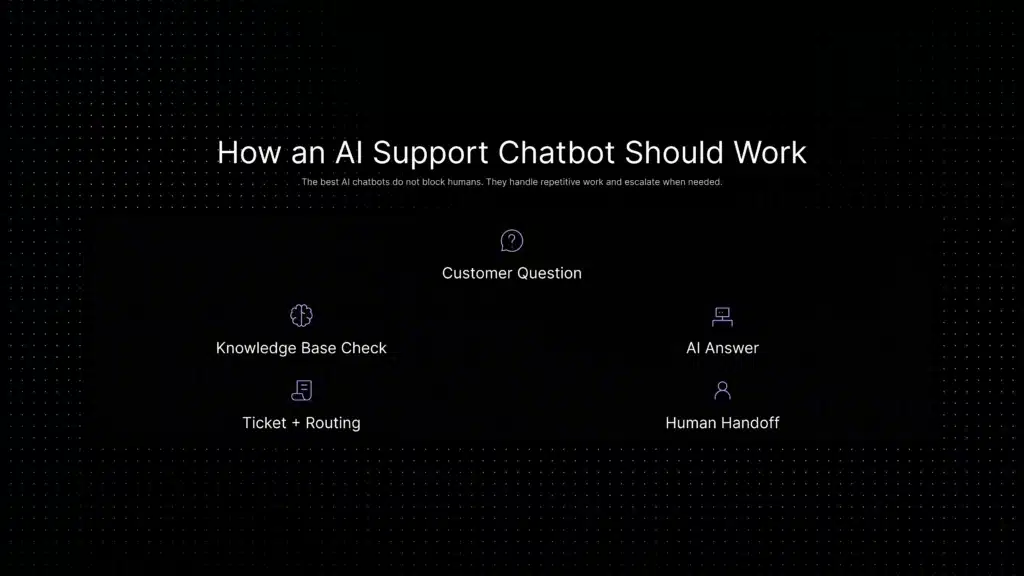
The chatbot should know when to stop. When it escalates, the human agent should receive the conversation history, customer context, and what the bot already tried. Nobody wants to explain the same bug three times to three different lifeforms.
3. Omnichannel support
Customers do not care which channel your team prefers. They message through chat, email, WhatsApp, SMS, social media, and sometimes whatever ancient contact form your website forgot to delete. Your AI support chatbot should fit the channels your customers already use.
4. Ticketing and workflow automation
AI is more useful when it connects to actual support operations. That includes creating tickets, assigning owners, setting priority, routing conversations, triggering workflows, and helping teams follow up.
5. Analytics and resolution reporting
You need to know what the chatbot resolved, what it escalated, where it failed, and which help articles need improvement. Otherwise you do not have AI support. You have a mystery box with a chat bubble.
6. Security and data control
Ask specifically how customer data is stored, processed, and retained, and whether the vendor holds relevant certifications (e.g., SOC 2, ISO 27001) or supports data residency requirements if you're in a regulated industry (finance, healthcare, education).
7. Easy editing and support-team ownership
Support teams should be able to improve answers, update workflows, and adjust automation without waiting three sprints for engineering. The closer AI tuning is to the support team, the faster it improves.
Pricing Models: The Part Everyone Skims Until the Invoice Arrives
AI chatbot pricing usually falls into five models:
Per-seat pricing
You pay for each agent or user. This is predictable, but it may not reflect how much work the AI is doing.
Per-resolution pricing
You pay when the AI resolves a conversation. This aligns price with value, but it can become expensive as volume grows. Intercom Fin and Help Scout AI Answers are examples of this model.
Usage-based pricing
You pay based on conversations, messages, AI credits, or interactions. This can work well, but check caps and overage costs carefully.
Plan-based pricing
You pay for a tier with included features and limits. This is easier to budget, especially for small and mid-size teams.
Custom enterprise pricing
You talk to sales. Then sales talks to finance. Then finance talks to procurement. Then someone creates a spreadsheet that becomes the actual product owner. Enterprise software is a beautiful ecosystem, if you enjoy watching time evaporate.
Before choosing any customer support AI chatbot, ask this question:
If the vendor cannot answer clearly, that is already an answer.
When You Should Not Use an AI Chatbot
AI chatbots are useful, but they are not magic. There are cases where you should slow down.
Do not use an AI chatbot as the only support path for:
- High-risk billing disputes
- Legal or compliance-heavy questions
- Sensitive customer complaints
- Complex technical incidents
- Angry enterprise accounts
- Anything involving account security or private customer data unless permissions are very clear
The best setup is not “AI replaces humans.” The best setup is AI handles repetitive work, humans handle judgment. Wild idea: use machines for machine-like work and people for people-like work. Someone alert the innovation department.
How to Choose the Best AI Chatbot for Customer Support
Use this simple decision path.
Choose Inquirly if:
You are a SaaS team that wants AI support, ticketing, live chat, workflows, omnichannel conversations, and knowledge base management in one workspace. You want to move faster without becoming trapped in enterprise complexity.
Choose Intercom Fin if:
You already use Intercom heavily and want AI inside your product-led messaging experience.
Choose Zendesk AI if:
You are a larger support organization with complex routing, reporting, and enterprise support requirements.
Choose Freshdesk Freddy AI if:
You are already using Freshdesk and want AI added to familiar help desk workflows.
Choose Ada if:
You are an enterprise team with very high support volume and a dedicated automation program.
Choose Tidio if:
You are a small business that needs live chat and AI support quickly.
Choose Gorgias if:
You run ecommerce support and need order-aware automation.
Choose Help Scout AI if:
You want simple shared-inbox support with practical AI assistance.
Choose eesel AI if:
You want to add AI on top of your existing tools without replacing the helpdesk.
Choose Chatbase or Botpress if:
You have a technical team and want to build or customize your own AI chatbot experience.
Final Verdict
The best AI chatbot for customer support is not the one with the loudest homepage. It is the one that fits your support workflow.
If you are a SaaS team and want AI support connected to ticketing, live chat, knowledge base, workflows, and omnichannel conversations, Inquirly is the strongest fit. It gives growing teams the pieces they need to automate repetitive support without turning the support stack into a giant enterprise machine.
If you are already deep inside Intercom, Fin is a strong choice. If you are an enterprise running a mature support operation, Zendesk AI or Ada may be better. If you sell online and most tickets are about orders, Gorgias deserves attention. If you want to build custom bot logic, Chatbase and Botpress are more flexible.
The boring but correct answer: start with your support reality. What questions repeat? Where does your team lose time? Which channels matter? How good is your knowledge base? How much cost surprise can your finance team survive before becoming a folklore creature?
Choose the AI chatbot that solves those problems. Not the one with the best demo confetti.
Start with Inquirly and see how AI-assisted customer support can work without making your team babysit another complicated platform.